
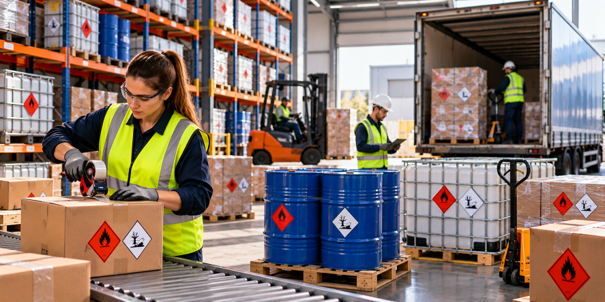
ADR Training for Warehouse Workers
Warehouses play a crucial role in the dangerous goods transport chain. Before a consignment reaches a vehicle, warehouse personnel may receive the goods, inspect packages, prepare pallets, create overpacks, apply labels and markings, check documentation and load the shipment. A mistake at any of these stages can result in a dangerous goods consignment entering the road transport chain incorrectly prepared.
For UK businesses, ADR training for warehouse workers is therefore an important part of dangerous goods compliance. However, not every person who works in a warehouse automatically requires exactly the same training. The decisive factor is the employee’s function and whether their duties concern the carriage of dangerous goods.
ADR Chapter 1.3 establishes training requirements for personnel involved in dangerous goods transport, while UK Department for Transport guidance also identifies operational personnel such as loaders, packers, fillers and unloaders as groups requiring appropriate dangerous goods security awareness.
Why do warehouse workers need ADR training?
Dangerous goods transport does not begin when a lorry leaves the warehouse. In regulatory and practical terms, many important transport activities have already taken place before the driver receives the consignment.
Imagine a pallet containing flammable liquids. Warehouse personnel may check the individual packages, combine them on a pallet, wrap the pallet as an overpack, ensure the necessary markings and labels remain visible or are reproduced on the overpack and finally load it onto a vehicle.
Every one of these activities can influence compliance.
The same applies when warehouse workers handle corrosive substances, aerosols, paints, cleaning chemicals, lithium batteries or other dangerous goods. Employees need sufficient knowledge to recognise when special transport requirements apply and understand the limits of their own responsibilities.
ADR training helps turn labels, UN numbers and transport procedures into information employees can actually use during their work.
Which warehouse employees require ADR 1.3 training?
The requirement should be assessed according to function rather than job title.
An employee whose only activity is picking ordinary consumer products in an area completely unrelated to dangerous goods transport will have different training needs from someone preparing dangerous goods for collection.
Warehouse personnel who receive, pack, prepare, mark, handle, load or unload dangerous goods are much more likely to perform functions directly connected with ADR. Employees responsible for checking shipments or preparing dangerous goods documentation can also fall within the training framework.
The Department for Transport specifically identifies operational personnel including loaders, packers, fillers and unloaders among the groups commonly involved in dangerous goods carriage. Administrative personnel responsible for matters such as consignor or consignee paperwork can also require appropriate training.
This makes it important for employers to map dangerous goods responsibilities within the warehouse rather than simply training employees according to their department name.
Recognising dangerous goods in the warehouse
One of the first things warehouse personnel need to understand is how dangerous goods can be recognised.
ADR divides dangerous goods into hazard classes. Packages may carry diamond-shaped hazard labels indicating hazards such as flammability, toxicity, corrosivity or other dangerous properties. UN numbers provide an internationally recognised identification system for dangerous substances and articles.
Warehouse workers do not necessarily need to become dangerous goods classification specialists. They do, however, need enough knowledge to understand the information relevant to their duties.
For example, an employee preparing a shipment should recognise that a package bearing a Class 3 flammable-liquid label cannot simply be treated as an ordinary cardboard box. Similarly, a package containing lithium batteries may be subject to particular marking, packaging and transport requirements.
Recognition is the first step towards preventing errors.
Checking packages before transport
Warehouse workers can provide an important final check before dangerous goods enter the transport chain.
A package that is leaking, damaged or incorrectly closed should not simply be loaded because it appears on the warehouse picking list. Personnel need to understand when something is abnormal and when the shipment should be stopped and referred to an appropriately competent person.
Labels and markings also matter.
A package can contain the correct substance in the correct packaging but still create a compliance problem if required information is missing or obscured. Warehouse employees involved in preparing consignments should therefore understand the significance of the labels and markings relevant to their work.
The objective of training is not to make employees memorise the entire ADR. It is to give them enough competence to perform their functions correctly and recognise when expert advice is required.
Packaging and overpacks
Packaging is particularly relevant in warehouse operations.
Dangerous goods may need to be transported in packaging that satisfies specific ADR requirements. Employees responsible for packing should understand why the correct packaging matters and why apparently minor changes – such as using a different box or closure – cannot always be made without considering dangerous goods requirements.
Overpacks are another common warehouse issue.
Several dangerous goods packages may be combined on a pallet and wrapped for easier handling. Employees preparing these units need to understand that creating an overpack can introduce additional marking and labelling requirements, particularly where the required markings and labels on the packages inside are no longer visible.
This is a good example of why function-specific ADR training is necessary. A general introduction to dangerous goods may not be sufficient for someone who regularly prepares dangerous goods pallets for road transport.
Loading and unloading dangerous goods
Loading is more than moving a pallet with a forklift.
Before dangerous goods are placed on a vehicle, personnel may need to consider package condition, load security and other requirements relevant to the goods being transported. Some combinations of dangerous goods can also be subject to restrictions.
The employee therefore needs to understand the procedures applicable to the loading function.
Unloading requires similar awareness. Damaged or leaking packages can present additional risks when moved, while unexpected package condition may require the normal unloading process to be stopped.
ADR training should consequently be combined with the warehouse’s practical procedures. Employees need both regulatory awareness and clear instructions about what to do when something is wrong.
General awareness, function-specific and safety training
ADR 1.3 is built around the idea that training should correspond to the employee’s responsibilities.
General awareness provides employees with an understanding of the dangerous goods transport framework. Function-specific training addresses the requirements directly relevant to their duties, while safety training focuses on the hazards presented by dangerous goods and the measures needed to reduce risk.
For a warehouse worker, these elements can come together naturally.
The employee learns what dangerous goods are and how they are identified, then learns what ADR means for their specific tasks, such as preparing packages or loading pallets. Safety instruction then connects that knowledge with the hazards that may arise if a package is damaged, leaking or handled incorrectly.
Dangerous goods security in the warehouse
Security is another important aspect of ADR training.
The Department for Transport states that anyone engaged in the carriage of dangerous goods must consider security requirements appropriate to their responsibilities and the loads involved. Training should cover the nature of security risks, recognition of those risks, methods for reducing them and the action to take if a security breach occurs.
Warehouses can present particular vulnerabilities because dangerous goods may be temporarily stored while awaiting dispatch. Unauthorised access, insecure vehicle keys, poorly protected shipment information and unauthorised persons entering sensitive areas are among the issues highlighted in UK guidance.
Warehouse personnel therefore have a role not only in safety but also in maintaining the security of dangerous goods.
Training before carrying out dangerous goods duties
Training should not be postponed until an employee has already been carrying out dangerous goods activities independently for several months.
UK HSE guidance on ADR Chapter 1.3 explains that training should be completed before a person assumes responsibilities relating to dangerous goods. Until the required training has been provided, relevant functions should only be performed under the direct supervision of a trained person.
This makes ADR training particularly relevant during warehouse onboarding.
Employers should identify dangerous goods responsibilities when a new employee starts work and provide appropriate training before that employee independently performs those tasks.
The same assessment should be made when an existing employee changes role.
Online ADR training for warehouse personnel
Online training can be a practical solution for warehouse operations where employees work different shifts or at multiple locations.
The E-learning ADR Awareness 1.3 (English) is for personnel involved in dangerous goods road transport. The course addresses ADR functions, classification, labels, packaging, shipping activities and the small-load provisions commonly associated with the ADR 1000-points calculation.
The programme consists of two modules followed by an online assessment. Participants need a score of at least 70% to pass and, after successful completion, receive an ADR Awareness Certificate that can be downloaded or printed. The current product page lists the course at £55.
For warehouse personnel who perform ADR-related functions such as packing, loading or unloading, this can provide a structured foundation for their dangerous goods knowledge. The online training should be complemented where necessary by workplace-specific instruction covering the actual substances, procedures, equipment and emergency arrangements used at the site.
Visit YourSafetyStore.co.uk and view the E-learning ADR Awareness 1.3 (English) in the ADR / Road Transport section.
Creating a safer warehouse and transport chain
Effective ADR training should ultimately change what employees notice during their everyday work.
A trained warehouse worker is more likely to question a leaking drum, recognise a missing hazard label, identify an incorrectly prepared overpack or stop a damaged package before it is loaded onto a vehicle. This creates an important control point before the dangerous goods reach the public road.
For employers, the best approach is therefore to identify which warehouse functions influence dangerous goods transport, provide training appropriate to those responsibilities, maintain training records and periodically review whether refresher or additional function-specific training is necessary. UK guidance also requires security training to be provided or verified when someone takes up a position involving dangerous goods transport and periodically supplemented with refresher training.
ADR training for warehouse workers is consequently much more than learning what the hazard diamonds mean. It gives employees the knowledge to understand their role in a larger transport process – from the moment dangerous goods enter the warehouse until the correctly prepared consignment leaves the loading bay.
